Showing posts with label writing. Show all posts

Wednesday, March 1, 2017

Here’s A Handful of M & M s


Writing is like an all day sucker sometimes; just not worth the effort and time for sticky lips.  But other times, writing is itself a sweet reward.  Most of the time, though, it is a must-do item on our list that evokes a lot of anxiety about how to start, how to get through it, how to do this, then that, and get it done!  I am going to take a few lessons from my book, KISS Keep It Short and Simple, to use as “M & Ms—The Mechanics and Magic of Writing” to illustrate how a few simple techniques can make alchemy happen.

The computer has redefined how to write a paper, both in content and mechanics, as the internet has given unlimited resources for the writer and word processing has eliminated a host of difficulties, such as formatting and spell checking. While that is a wonderful thing for all writers of all ages, the authors, students, professionals and non-professionals alike, most of us have angst when it comes to actually putting ideas into an organized presentation.  Texting and tweeting has destructured the sentence, and with emoticons, has fragmented thoughts into information of bits and bytes, making it even harder to organize and compile a composition.

But therein lies the beauty of writing:  chaos.  From all those swirling ideas, associations form from clustering ideas, memories, and sensory perceptions into coherency.  This is layering—write! doodle! play with it! and soon a theme emerges. When it pops! and it will, you then can arrange these elements into the topic of your paper.  The beginning of the paper states intent; the middle is explanatory; the last is summation.The critical difference in a composition, such as a business letter, essay or review, and social media posts, is a complete sentence. As you see the theme take shape, begin to organize it into paragraphs, using the CCI: Compare, Contrast and Interrelate technique. Remember, the rule of three (at the least): each sentence has a noun, verb and adverb;  three sentences in a paragraph, three paragraphs for a composition.

That’s it.  That’s all there is to it. Grab some chocolate goodies, put on your wizard’s hat and write!

Wednesday, December 7, 2016

The Write Seasons Greetings

I have to take stock of the pantry, order the prime rib, buy the ingredients for the  pies, edit the address list, Mary Sue likes Cran-Apple juice, Ted likes V-8, Sugar Snaps is toddling, put the tree up on a box or table, and I forgot Sissy’s birthday card.  If I could just get out the newsletter, a really good one, that would take care of half the obligatory notes in the one-hundred ten Christmas cards.  I can do that between the 9th and 10th and get all those in the mail with all the packages, on time for Christmas Eve.

Or, I could just forget it.  But every year I argue with that inner voice that urges me to do a creative newsletter, maybe with an artful, hand drawn Santa and sleigh over the roof tops, or a bucolic scene with deer and bunnies and magically decorated trees, snow falling, and of course, starry night sky—-ah, no, if it is snowing it wouldn’t be starry, then maybe snow on the ground.  Or quick! copy a graphic and send out e-cards. Oh, right.  Now I am exhausted just thinking about it.  Why does it have to be so hard?

Well, it does not have to be hard.  I know, I wrote the book KISS, Keep It Short and Simple, and I’ve learned how to quick start a writing project. Although it sounds contradictory, listen to the chattering thoughts a few seconds.  Is there a recurring theme—-leaving out all the expletives?  For me this year, there is nothing particularly newsworthy. Okay, then, what about an artsy approach?  Hmmm, what pops in mind is a wine glass pouring out words onto the paper.  Okay, I can go with that and a simple line that the family is happy, healthy and will be celebrating the holidays together.  Last year, the newsletter had twelve  paragraphs bulging with anecdotes, some hilarious and some quite disheartening, in a calendar format, as my life had been one incident after another the whole year. I could laugh about it in retrospect and apparently, so could others.

What makes a good Christmas newsletter?  News about the family. It is in the telling. “Well, it’s that time of year again….” does not make for a felicitous greeting.  Start on a positive note, simply “Merry Christmas!” can be a good start to a chatty newsletter.  If you are not good on the computer with graphics, buy some seasonal cheerful paper which has the added benefit of shortening the format.  The idea is to make your readers feel as though you are talking to them, not bragging or to induce envy of your good fortune or make others feel sorry for you, or dread hearing the same old thing from you year after year. It is a short story. Short sentences are far easier and memorable than long, run-ons. Remember that a sentence is built on threes:  a noun, verb and adjective; a beginning, middle and end, and at least three sentences to a paragraph. Use the CCI concept:  compare, contrast and interrelate. As an example:  We were so fortunate to have our clan, six couples, 5 children, one bachelor, together for a Christmas ski vacation. Our nephew Kyle, a competitive racer broke a record in the Jingle Bell run, but unfortunately, also broke his ankle the first day. However, as all true romantic stories have a happy ending, by the end of the week, Kyle was engaged to his high school sweetheart, a charming waitress who brought him a daily cup of coffee as he sat by the fireplace. Kismet?

I suspect for most people, it is hard to find the right tone, or voice, to write one’s story. Is it far nobler to be serious or more impressive to be charming, witty, and funny? Or far better to be yourself, which may be plain spoken, out-spoken or reticent.  If the whole thing of writing out a newsletter is overwhelming, don’t stress, address.  Get the envelopes done and the letter becomes an accessory.  Once you begin, the rest will come easy.

Then again, “Merry Christmas! Happy New Year y’all” works  like a charm, too.  Sign your name to the card and you are good to go.
Happy Holidays
Jacquie

Wednesday, October 12, 2016

Share Why You Write on The National Day on Writing

“We all have our own reasons for why we write, and many are essential to accomplishing our daily plans, not to mention achieving our dreams.” - NCTE Why I Write

Join me and thousands of Americans as we celebrate The National Day on Writing on Thursday, October 20th. Founded by the National Council of Teachers of English (NCTE), the day draws attention to the importance of writing in all of our lives.

From text messages and social media posts to journals and novels, all of us write something every day. And, helping the younger generations understand how crucial writing is to communicating their thoughts is what English teachers around the country work tirelessly to do.

Join the celebration!
Ready for a writing challenge?
Participate in the National Novel Writing Month next month! Sign up on the website  to connect with fellow writers to get the support you need to finish before the end of November. Do you think the world is ready to hear what YOU have to day?

Wednesday, January 20, 2016

Chaos and Creation

Everyone is creative: it is how you manage the process that makes the difference. The creative process is messy and chaotic, but a necessary part of creation. Talking with students of all ages, the one thing that stymies the project from getting started is how to begin, how to jump into it, organize it and see it through. I have a mantra I say to myself: trust the process.

We create in our waking and sleeping lives, using words and images to communicate. A thought is words put in order, to talk to oneself or another, to make a shopping list, cook a meal, get through the daily activities. Routines help us to corral the chaos into a manageable process, from the basics of learning ABCs, tying shoelaces, reading and writing to more sophisticated skills like driving a car, using a computer, and navigating the social and career spheres.

Sometimes it is easier to do than other times, when it seems that chaos reigns. I can compare the process with quilting. Some quilts go together simply, effortlessly, with minimal effort, like the Tardis Quilt, while others require revision after revision. The picture is a quilt I am working on for my daughter and her husband. I knew the theme would be a star quilt; I culled images from the internet and books I have in my library before I found the Friendship Star pattern I liked. Now what? He is a Taurus and she is a Virgo; the constellations map out beautifully for a quilt—but it has taken me over one hundred sketches to get the right layout—and then I have revised the colors and combinations five times before I was satisfied. My work space is perfect for doing large projects and I can keep organized as I am working. The theme came after I had bought the material, which was unusual for me, but nothing quite sounded right until snap! the thought Stars Falling Love, was just right. It is coming together, but slowly...the longest it has taken me to finish a quilt.

But during this process I had an insight into what is known as ‘writer’s block’, or that frustrating state when the project stalls out. I walked away from the sewing machine and sat outside on the deck stairs, thinking. I second-guessed every step, every completed star block, every color combination until I could no longer work on the quilt. Why is it not going smoothly? Why?Why?Why? Because, I want it to be perfect and all I can see is mistakes. Is it going to be beautiful like I envisioned? If it is not done, then I do not have to answer that question.

And so it goes with writing. My first book, Forcing the Hand of God, was first a series of inter-related short stories I had done for my master’s thesis. I was in a professional writer’s workshop, and had a wonderful, astute group of writers to critique my manuscript. That book was a learning process and I honed my skills as a writer, which took four years, from first draft to finished manuscript. My next project, KISS Keep It Short and Simple, was a compilation of notes that I had kept for various workshops I had given for beginning writers; it pretty much was a matter of organizing and filling in chapter headings before it went to the typographer, who added some absolutely amazing graphics that made the finished book charming. The first of the Bully Dog series, the story and characters of Bully Dogs, came holistically to me, and with the advent of the word processor and computer, was a week in the writing and two months in the revisions. The second book, YNK (You Never Know) took six months of conception, three weeks to write and two months of revisions before I let it go to print. The third book, A Penny in Time, actually was a stand alone story until I had written the other two and realized that Dusty belonged with Fran and her story fit with the series. The last book, Forever and a Day, has been a slog, but the first draft is done and awaits revision.

I do a lot of thought processing in writing stories, as you may have guessed from all this. Much of my time is spent back and forth, up and down and through hoops of what-if-this-then-that-will-it-work even before I type the title onto a page to begin my writing project. I make copious random notes, on characteristics, scenes, descriptions of clothing, hair color, likes/dislikes of the various persons and familial relationships—not all of the information necessarily makes it into the story line. I had one character that badgered me for over a year to write her story. Finally, I gave in and wrote the story—it is technically a perfect short story, but trite; I did not want to write about her because it had been done before by much better writers than I. When I get through the first five chapters of my new book, Eye of the Moon, which is set on a colonized planet in our solar system, this story will be an appropriate and pivotal chapter in the book.
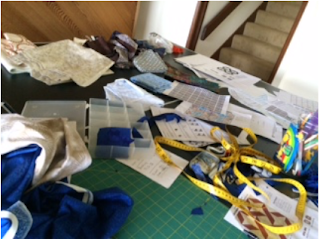
Vision, envision, revision—imagination—reality—dreamscape; all a part of the chaos of creation. My advice is to trust yourself that you know what you know and by putting those thoughts into order, you can begin at the beginning and get to the end of a project. As in quilting and writing, an organized workspace is vital to contain chaos; break down the project into manageable components. In quilting, it is the block pattern, for writing it is one sentence after another, one paragraph then another. In writing, compare, contrast and inter-relate ideas, as you would in any project, from a grocery list to an essay. The very action of beginning with a pencil, or a blank document, takes that idea and makes it concrete. From imagining it to visualizing it to producing it, trust the creative process that from chaos comes creation. It will take time, it will take effort, it will, in the end, be beautiful.

Wednesday, October 14, 2015

Book Review: Something to Ponder


These two books by Kate Atkinson came highly recommended to me to be read as companion pieces, which made a lot of sense after I finished reading them. I would have read A God in Ruins just for the title alone, but found the continuing saga of the Todd characters worth my attention from the first jarring chapters of Life After Life.

I admire the skillful and masterful writing of Kate Atkinson, but found a good deal of tedious characterization and details of World War II off putting. But her books are the kind I love to analyze and write essays about, delving into “the meaning of” one thing and another, and hav
ing something to ponder.

Curious? Read other reviews of these wonderful novels:
New York Times Sunday Book Review -
Subject to Revision: ‘Life After Life,’ by Kate Atkinson

"Its [Life AFter Life's] heroine, Ursula Todd, keeps dying, then dying again. She dies when she is being born, on a snowy night in 1910. As a child, she drowns, falls off a roof and contracts influenza. Later, she commits suicide and is murdered. She is killed during the German bombing of London in World War II and ends her life in the ruins of Berlin in 1945. Each time Ursula dies, Atkinson — a British writer best known here as the author of Case Histories, the first in a series of highly entertaining mysteries featuring the sleuth Jackson Brodie — resurrects her and sets her on one of the many alternate courses that her destiny might have taken." Read the entire review>>


The Guardian -
A God in Ruins by Kate Atkinson review – her finest work

"A God in Ruins is the story of Teddy’s war and its legacy, 'a ‘companion’ piece rather than a sequel', according to the author. At first glance it appears to be a more straightforward novel than Life After Life, though it shares the same composition, flitting back and forth in time so that a chapter from Teddy’s childhood in 1925 sits alongside a fragment of his grandchildren’s childhood in the 1980s, before jumping back to 1947, when Teddy and his wife Nancy, newly married, are trying to come to terms with the aftermath of the devastation: 'The war had been a great chasm and there could be no going back to the other side, to the people they were before. It was as true for them as it was for the whole of poor, ruined Europe.'"  Read the entire review>>

Do you enjoy reading books as much as I do? Connect with me on Goodreads and/or Shelfari! Both are great places to find new favorite books and I'd love to see what you're reading!

Friday, August 28, 2015

That’s Life

Sometimes life imitates art--in my case, a novel in progress, and a bad one at that, although there are some very sound elements of good writing. As I have taught for years in my writing workshops, all writing projects have the same basic structure: a beginning, a middle and an end. And each component of the writing process is building blocks of three. There is in any story a conflict: one against oneself, one against another, one against God. Like many good stories, my story incorporates them all, and I am still looking for a resolution. Maybe I unearthed a cosmic truth, because it all started with a plane trip to Honolulu to get the fourth book of the Bully Dogs series completed in draft for my readers, so that I could fulfill my promise to have the book done before the next Ice Age.

I had recently had new blinds installed and the facia popped on a few of them, requiring the installer to come back and repair them. When I saw that one had a bulge, rather than call again, I thought I would just fix it myself. The chair was the right height, but the material a little slippery; falling off, I hit the back of the chair’s edge, which left me in considerable agony with a nasty, painful bruise on my whole left side which curtailed any walking expeditions for most of the week.

But I could still sit at the computer and write while the vacuum-bot did its job to clean The Vog grit up; only it would sweep for a minute and then park itself next to me. Weird and just a bit creepy. But it did decide to work the third day and brought me a dead cockroach. “Oh, thanks,” I said, from on top of the couch, “for doing your job.” I am okay once I have on rubber gloves and shoes to pick up and dispose of the carcass, but it was quite a maneuver to get from the couch to the kitchen without getting within six feet of the bot.

On the last day, as I am leaving for the airport, because I was early to the lobby and the cab was not due for another ten minutes, I, in my obsessive mode, decided to do another visual sweep of the condo, just to make sure the stovetop burners were off, the hot and cold water to the washer tight and off, and the all faucets completely shut off. The last room I checked was the front bathroom, and there beside the toilet was a big bug (when I did an internet search, the closest match was the Great Asian Horned Beetle). I wear a size 7-1/2 shoe and it was longer than that. I had no time to deal with that thing; it would require me to change into jeans, socks, boots, long-sleeved shirt, gloves, sunglasses and hat. I had a cab waiting downstairs, so if my sonic scream did not kill it, and Heaven forbid it is a pregnant female, I had to leave it for another time. My daughter has a first year wedding anniversary coming up in September and I have offered them airfare and a place to stay while they are in Oahu.

I am telling this to my daughter who has stayed the night at my house—”oh, by the way, Mother, the air conditioning is not working”—so that she and her husband can borrow the Ford Explorer to go whale watching up at Anacortes on Wednesday. She laughs, miming the big bug to small bug with forefinger and thumb as she pulls away from the driveway; an hour later she is frantically trying to call me to tell me the car has blown an engine on I-5. The main reason I still have a landline is that cell calls are dropped here at my house; that day, apparently work was being done on the substation and we were temporarily out of service. My cell phone was doing a software update for twenty-five minutes and then would not let a call be completed. But, in the end, cars were switched, broken-down car towed, and daughter got some awesome pictures of whales.

But, the saga continues. Thursday morning, July 4th, at about 4 AM, my husband wakes me with the dreaded, “I think we have a problem.” Usually that problem would be waking me at 4 AM. A six dollar part broke on the upstairs toilet and gallons of clean water damaged the upstairs and downstairs of our house. On the hottest, record-breaking day of the year, we are without air conditioning (which is out of warranty) until July 29th. And, those big blowers that Servpro installed throughout the house to dry out everything jacked the temperature up to 106 degrees. “Why can’t we go to a motel?” I screamed at my lizard-husband, “Think of it as a long weekend of camping!” He just waves to me as he drives off to his air conditioned office. Well, my idea of camping is room service at the Kahala on Oahu.

What is life’s lessons here, I wondered? Not to let things bug me? Don’t sweat the small stuff? After all, nothing of value was lost, but time and temper and money. I got the exact car, down to the color, I have wanted to trade the Explorer for when I rented the Ford Edge. And sweating is a good way to detox the body, right?. I have yet to figure a life lesson connection to the air conditioning, the frozen engine, and toilet; but as husband pointed out, all three had something to do with water. Not to drown in self-pity? Perhaps it has something to do with Karma and patience; I think I could be a whole more patient in Hawaii. So I have decided that the theme of this year in the life of me is: “That’s Life!” the lyrics by Dean Kay and Kelly Gordon, and the most famous version by Frank Sinatra. I’m just gonna change the last lines a bit from:
But if there's nothin' shakin' come this here July
I'm gonna roll myself up in a big ball a-and die
My, my! 

to:
But if there's nothin' shakin' come this here July
I'm gonna roll myself up in a big ball a-and fly
Fly! Fly! 
 My daughter just informed me that buying a one-way ticket to Honolulu is not a good option, as there is a tropical storm moving in. (Sigh.) Well, as they say, that’s life.

Thursday, May 28, 2015

Pay Attention!

Pay attention! Jennifer Adams has a powerful voice and she knows how to use it. She has a lot to say about bullying. During an interview with Jennifer, she and I covered multiple issues that had to to do with her disabilities; she was born without limbs. No hands, no feet, but a beautiful voice that she uses as a professional singer, motivational speaker and as an advocate for those with disabilities. Jennifer has a Bachelor of Arts in Psychology and a minor in Vocal Performance from Pacific Lutheran University, followed by a Master of Arts in Counseling from Faith Evangelical Seminary, along with a Certification in Applied Technology in Radio Broadcasting. She has been a working woman in the fields of Tele-communications, Radio Broadcasting, Public Speaking and Education. She has published two books, Discover Your Identity and Dreams Come True! And she won the title of Ms. Wheelchair America 2014.

While friends and family may forget about Jennifer’s disabilities, a lot of people are discomfited by her, for many reasons. As a child, Jennifer was bullied unmercifully in school, which demoralized her and plummeted her into depression. We discussed what makes a few people, especially children, behave so meanly towards her and others with disabilities. It is her “otherness”, not like a “normal” person. It is ignorance, a lack of social skill on what to expect from a disabled person, and how to respond to someone with limited capabilities. If you do not look like me, then you are in another category, one of “them” not one of “us”. 

Another facet of the “otherness” that makes people uncomfortable, is if a disabled person is more accomplished than I am, what does that say about me? Most adults lack experience with disabilities and find it embarrassing to be around someone who has obvious needs, but what are you supposed to do for that person? When I think I am being compassionate and helpful, am I being patronizing? What can I expect a disabled person to do for himself or herself? There is an element of superiority in an attitude of "helping" someone too much, to the point of disrespecting the disabled person by not acknowledging the person as someone who can think, act, and be valued as a person, just like you.

Jennifer is not to be pitied. It is not necessary to treat her like a child because of her limitations. Upon first meeting her, there is an alarming moment when you see her as vulnerable—"she needs help!"—but after only a few minutes being with her, you think “Wow! she isn’t crippled! She can do a lot for herself!” It is evident that she is very capable and independent, but recognizes that she did not get "here" without help from family, friends and strangers. There is the problem of mechanics, getting from point A to point B, all the physical barriers that do not present problems for most people. On a daily basis, it is the small kindnesses of those she interacts with; opening a door, making extra room for her wheelchair, reaching for that hard-to-get-to item, holding the elevator for her entrance, the small niceties that people do for each other. And in doing these things for another, one’s humanness is respected, rather than another’s "otherness". We are “pack animals”, with tribes, clans and families, all interdependent upon one another on a daily basis, all of our lives.

Jennifer would like to put you at ease with her disabilities, so that you can appreciate her, and those with disabilities, as persons deserving respect and acceptance. Jennifer is a strong, confident woman who has challenges, but also someone with a sublime voice that has a message for all of us. Be inspired by Jennifer Adams at www.jenniferlynnadams.com

Wednesday, April 29, 2015

Jenny Adams and The Power of Words

I am thrilled to introduce to you a new guest writer here on my blog: Jenny Adams, motivational speaker and fellow anti-bullying advocate. She also happens to be my husband's niece! Today's guest blog post is a short introduction to Jenny and her work. Watch for more from Jenny in the coming months.

"I am an entrepreneur of a motivational speaking business SHIFT.Through SHIFT I have an anti-bullying/pro-inclusion campaign called "The Power of Words." This anti-bullying/pro-inclusion campaign was inspired by my own experiences with the power of words in my life. This campaign demonstrates to students the power of words and how they affect the world around them. The "Power of Words" message has a great impact on youth as I use a mixture of humor and frankness to reach them in a profound way. I also have a question and answer portion to the assembly along with teaching the kids a song.  I am also the former Ms. Wheelchair America 2014 and have shared the message of the "Power of Words" all over the nation in schools and youth conferences.

I also have a workshop, "Discover Your Identity." This workshop was inspired by my own search and discovery of my identity. I was born with partial limbs and have overcome my limitations by knowing my identity. I have shared the message of this powerful workshop throughout the U.S. in schools, universities, businesses, and conferences.

I know the power of identity from my own life experiences, therefore my passion is that youth would connect with their identity and purpose in the world. This is a great workshop for leadership and diversity training. This life changing, interactive workshop inspires students to discover and pursue their identity and purpose by unlocking the power of mutual encouragement and vision.

I also do advocacy work for people with disabilities. You may learn more about me and my story on my website www.jenniferlynnadams.com.

I believe in where I am going. I believe one day there will be stadiums of people waiting to hear me speak. I believe my business will go international."

And here's a fascinating article I found at Psychology Today that provides more information about the scientific evidence for the power of words and practical advice for moderating your own speech patterns to avoid inflicting emotional pain on others.

When Words Are Weapons: 10 Responses Everyone Should Avoid
Do your words do you and others justice?
by Peg Streep, PsychologyToday.com

"Of all the adages that get bandied about, perhaps the most wrong-headed is 'Sticks and stones can break my bones/ But words can never harm me.' We all know from experience that it isn’t true –whether we wept with shame in the schoolyard as children, were reduced to quivering jelly by a parent’s criticism, or were torn apart by a lover’s contempt—but now science knows why.

It turns out that the brain receptors for physical and emotional pain are one and the same so, yes, you can have your heart and spirit broken more literally than not. There’s some evidence that the over-the-counter remedy for physical pain works for emotional pain too. It turns out too that when pain is inflicted intentionally, the hurt is greater—which is all the more reason to pay attention to the words that come out of our mouths. Years ago, when I was in graduate school in English, there was a professor who was justly famous for his withering put-downs of his students; it was said that his insults were so subtle and “rapier swift” that the victim wouldn’t know he’d been wounded until he saw the “blood.”" Read the entire article>>

Wednesday, October 29, 2014

Writing with a Purpose: Prevent Bullying

In Other Words: One Author’s Personal Journey to Address & Prevent Bullying
by Trudy Ludwig

I haven’t always been a children’s author. Previously, I was an advertising/marketing copywriter. I did this for about 15 years—even though I didn’t feel passionate about my craft. Don’t get me wrong. I knew I loved to write. I just didn’t love what I was writing. My professional life shifted 11 years ago when my daughter, a second grader at the time, became the target of some bullying friends. It was one of those experiences that had a profound effect on both of us. 

How do you explain to a 7-year-old…
… the complexity of friendships?
… why her best friends one day can become her worst enemies the next?
… how to gravitate to kids who can accept all the goodness she has to offer and give it back in kind?

I went into research mode to find out as much information as I could about relational aggression, a form of emotional bullying hidden within friendships that often goes below the radar of parents and teachers. I learned that relational aggression (i.e., gossiping, spreading rumors, intentional exclusion, the silent treatment, etc.) is evident as early as preschool and appears to peak in middle school.

Researchers report that relational aggression is much more pervasive than physical aggression in our nation’s schools. Kids—both boys and girls—also find it more hurtful than physical aggression. In my search for age-appropriate books to address the very real and rampant problem of social cruelty among peers, I came up empty-handed.

Frustrated with this resource gap, I wrote MY SECRET BULLY (Riverwood Press, 2003) to help empower children to make healthier friendship choices. The outpour of positive reviews and heartfelt responses from young readers, parents, educators, and bullying prevention experts and organizations gave me the impetus to continue writing more books to help kids connect with their peers in helpful, rather than hurtful, ways.

Read the entire article at Reading.org>>

Wednesday, October 8, 2014

Author Spotlight: Trudy Ludwig

Trudy Ludwig is the award-winning author of a number of books for young children including The Invisible Boy, Better Than You, Confessions of a Former Bully, and My Secret Bully. Her focus is on helping young children navigate the social world of friendships, teasing, and bullying. Her first book, My Secret Bully, was inspired by the experiences of helping her own daughter deal with bullying from her friends. All of Ludwig's books are wonderful jumping-off points for conversations with kids about their own social interactions and experiences.

My Secret Bully 
"Here is the all-too-familiar story of Monica. She and Katie have been friends since kindergarten. Monica loves being around her when she's nice. But there are times when Katie can be just plain mean. And Monica doesn't understand why. Monica is a target of relational aggression, emotional bullying among friends who will use name-calling and manipulation to humiliate and exclude. But with a little help from a supportive adult—her mother—Monica learns to cope and thrive by facing her fears and reclaiming power from her bully."

The Invisible Boy 
"Meet Brian, the invisible boy. Nobody ever seems to notice him or think to include him in their group, game, or birthday party . . . until, that is, a new kid comes to class. When Justin, the new boy, arrives, Brian is the first to make him feel welcome. And when Brian and Justin team up to work on a class project together, Brian finds a way to shine...This gentle story shows how small acts of kindness can help children feel included and allow them to flourish. Any parent, teacher, or counselor looking for material that sensitively addresses the needs of quieter children will find The Invisible Boy a valuable and important resource."

Confessions of a Former Bully 
"Ten-year-old Katie finds herself where no child wants to be, in the principal’s office with both her parents. Caught bullying a friend on the school playground, she must meet with the school counselor once a week and figure out how to atone for her actions. As Katie learns more about herself and her options, she keeps a diary-like notebook of reflections and advice as well as facts about physical, emotional, and cyberbullying; why people bully others; and what tools kids can use when they experience or witness bullying."


Just Kidding! 
"D.J.'s friend Vince has a habit of teasing D.J. and then saying, 'Just kidding!' as if it will make everything okay. It doesn't, but D.J. is afraid that if he protests, his friends will think he can't take a joke. With the help of his father, brother, and an understanding teacher, D.J. progresses from feeling helpless to taking positive action, undermining the power of two seemingly harmless words."

Trouble Talk 
"Maya's friend Bailey loves to talk about everything and everyone. At first, Maya thinks Bailey is funny. But when Bailey's talk leads to harmful rumors and hurt feelings, Maya begins to think twice about their friendship... Includes additional resources for kids, parents, and teachers, as well as advice from Trudy about how to combat trouble talk."

Listen to Trudy Ludwig Chat About Her Work 
In this short podcast chat for parents of children in grades K - 5, Ludwig talks her book Confessions of a Former Bully and shares her Totally Awesome Empower Tools, strategies kids can use to assertively deal with bullying. Listen to the podcast here>>
 
More About Trudy Ludwig and Her Books

Wednesday, July 23, 2014

Writing Everyday: The Diary Habit

"It is necessary only that a life should be interesting to the person who lives that life. It you have a desire to keep a diary, it follows that your existence is interesting to you. Otherwise obviously you would not wish to make a record of it." - Arnold Bennett, author of Self and Self-Management: Essays on Existing (published in 1918) Read a longer excerpt here>>

30 Days to a Better Man Day 8: Start a Journal
via ArtofManliness.com
"My grandpa, Bill Hurst, was a journal writer his entire life. His journal was quite simple. He just kept a small notebook in the pocket of his pearl snap shirts and jotted down a short description of the things he did and the people he did it with. This is something he did pretty much every day for his entire life. He also kept extensive diaries of his time as a forest ranger in the Wasatch Range.

About 12 years ago, my grandpa took all these diaries and daily journal entries and began to write his memoir for his children and grandchildren. The finished product was a 500 page behemoth filled with stories from my grandfather’s life." Read the entire article>>

Thursday, June 19, 2014

Celebrating Resiliency: Kid Survivors are Everywhere

“...resilience is the ability to live creatively, with joy and satisfaction, whatever our circumstances. It’s like a beautiful flame inside of us that just needs fanning to take hold and transform any challenge into a gift. It’s a resource that when you call on it, can help you grow your life in surprising and beautiful ways.” - Becky DeGeorge, teacher and life coach

Writing for Resiliency: Young Readers as Survivors
By Sheila O'Connor, author of Keeping Safe the Stars

"[The Boxcar children] gathered dishes from the dump, made beds and brooms from pine needles, earned money for the family, found food, created their own home to replace the one they’d lost. They had integrity and courage, perseverance and imagination—all the qualities I longed for as a child.

Revisiting that story, I realized the deep impression that book had left on my young spirit, how much those resourceful children had informed the life I tried to live then, and later on the books I hoped to write.

For me, kids-on-their-own is more than a literary invention; it’s the life I lived, and the life countless kids still live now. In more ways than we’re able to imagine, kids get themselves to school, find food, feed their families, care for siblings, face challenges and miraculously find ways to solve problems for themselves.

Of course, I wish that it weren’t so; I always wish a parent or a teacher or a grandparent would step in to save the day, and often times they do, but just as often kids have to wait for help. Or ask. I see it in the schools; I see it on the street.

Kid survivors are everywhere. They’re in every neighborhood and school, they’re rich and poor, and too many of them have to keep their secrets to themselves.

When I write, whether I’m writing books for grown-ups or kids, a part of me is always in conversation with those children, survivor kids, kids who want to find their stories in a book."

Read the entire article>> 

Thursday, May 15, 2014

Journaling Just Might Be An Effective, Inexpensive Therapy Solution

Ready to explore how you feel about your life, experiences, hopes and dreams? Looking for a private, inexpensive form of therapy that just might improve your mental and physical health? Perhaps you want to strengthen your immune system, reduce stress, or eliminate some obsessions? Look no further than Journaling.

As a fiction writer, I find that I sometimes process the happenings of my life through the lives of my characters. Yet, I'm a big fan of keeping a private journal to record my thoughts and ideas. I wasn't surprised to learn that recent research has only proven what people have known since ancient times: regular sharing of your thoughts and experiences through writing can help in so many ways beyond simply recording the details of your life.

The Health Benefits of Journaling
By Maud Purcell, LCSW, CEAP (PsychCentral.com)

"I’ll bet you write (or word process) daily. If you are like most women, you record only what you must. In an effort to change your mind and your habits, I’ll let you in on a well-kept secret: A pen coupled with paper can serve as a powerful life tool.

Journaling (or keeping letters or diaries) is an ancient tradition, one that dates back to at least 10th century Japan. Successful people throughout history have kept journals. Presidents have maintained them for posterity; other famous figures for their own purposes. Oscar Wilde, 19th century playwright, said: “I never travel without my diary. One should always have something sensational to read on the train.”

Health Benefits
Contrary to popular belief, our forefathers (and mothers) did know a thing or two. There is increasing evidence to support the notion that journaling has a positive impact on physical well-being. University of Texas at Austin psychologist and researcher James Pennebaker contends that regular journaling strengthens immune cells, called T-lymphocytes. Other research indicates that journaling decreases the symptoms of asthma and rheumatoid arthritis. Pennebaker believes that writing about stressful events helps you come to terms with them, thus reducing the impact of these stressors on your physical health."
Read the entire article>>

Wednesday, March 19, 2014

Stories from Our Collective Past and a Modern-Day Golem vs. Bullies Story

Who doesn’t enjoy a good story? And some of the best stories I know are those that have been passed down through the generations and shared between cultures.

In honor of World Folktales and Fables Week this week, I’ve pulled together a list of some wonderful resources for enjoying the classic as well as the not-so-familiar stories from our collective past.

Some Fantastic Reads:
  • Tales of the Shimmering Sky: Ten Global Folktales with Activities Retold by Susan Milord (available at Amazon.com)
  • Not One Damsel in Distress: World Folktales for Strong Girls Collected and told by Jane Yolen (available at Amazon.com
  • Nelson Mandela’s Favorite African Folktales (available at Amazon.com)
Read Tales Online:
  • WorldofTales.com - A comprehensive collection of tales including King Arthur’s Knights, Grimm, Andersen, and Aesop as well as tales from countries from around the world
  • Pitara.com - Kid-friendly site with colorful graphics 
  • The Baldwin Project - A collection of Celtic fairy tales including “A Legend of Knockmany” and “The Shee an Gannon and the Gruagach Gaire” 
And, if a child in your life is interested in writing his/her own fairy tales or myths, be sure to check out Scholastic.com’s Myths, Folktales & Fairy Tales writing project that features tips and suggestions from popular authors like John Sciezka and Jane Yolen.

Let’s end our celebration of World Folktales and Fables Week with a review of Timothy Tolliver Bully Basher, an imaginative reworking of the Jewish Golem legend of a man of clay brought to life to protect the Jews from persecution.

This funny and short chapter book for children in grades 3-5 is written by award-winning professional storyteller Aaron Shephard (the Kindle version is currently available for free here).

When classroom bullies make life especially difficult for fourth-grader Timothy and his friends, they decide to take matters into their own hands by building their own robot to protect them.
"Yeah, but the Golem came first, and that was probably where the idea for Frankenstein came from." Arnie grinned. "Wouldn't it be cool if this robot could protect us from the Stinks, like the Golem protected the Jews?" 
At first “Joe” seems like a dream come true and a creative solution to their bully problem. But, like the original, Timothy’s Golem develops a mind of its own.

Timothy Tolliver Bully Basher is a fun adventure story with an important lesson. I think it’s a great book to read with your child and start a conversation about bullying. Be sure to visit the author’s website for more great stories.

Monday, March 3, 2014

Don't Never Forget to Celebrate National Grammar Day

It’s National Grammar Day this week and I’m sure you’re all celebrating by posting and sharing hilarious photos of spelling and grammar mistakes via Facebook and Twitter. While not a grammar geek myself, I do enjoy the various comics, quotations, and corrected signage photos that circulate around this time of year.

So, quick quiz: is it “first come first serve” or “first come, first served”? Was Ronald Reagan president in the ‘80s or the 80’s? Do you use the Oxford comma or not? What’s the difference between regardless and irregardless? Is it “could care less” or “couldn’t care less”?

Has your tolerance for talk of grammar reached its peak or has your interest been piqued by this peek at common errors?

If you want to brush up on your grammar or just impress your friends, spend a little time browsing the following sites this week. Fun and informative!
 And, of course, don’t miss the official National Grammar Day site.

If you’re looking for some funny fodder to share around the web in honor of National Grammar Day, look no further:
 Whether or not you’re a fan of grammar, I’d wager you might agree that even the best ideas dim when clouded by spelling errors, dangling participles, poor apostrophe usage, and the like. That’s why I regularly say, “Thank heavens for great editors!” Happy National Grammar Day to you all!

Thursday, February 6, 2014

Go Teen Writers!

As a child and teen, writing was a haven for me. I completely understand how important it is to be able to express your feelings without fear of recrimination. I've gathered together some excellent resources on encouraging teens to write and how teens can publish their writings. Hope you find them to be helpful!

7 Tips to Encourage Reluctant High School Writers (by SmockityFrock.com)
"Anytime I teach a writing class, I remind my students often that anyone who can talk or think can also write. Everyone has a voice. Learning how to get words on the page and becoming comfortable with using them is a challenge, but it’s a challenge worth taking. Writing is a worthy task for everyone." Read more>>

10 Things Teenage Writers Should Know About Writing (by John Scalzi)
Please read through the entire article to get to the best parts. "Excepting the freaks of nature,
which very few of us are, anything we decide to do takes us time to get good at. It’s just that simple. The figure I hear a lot — and which I agree with, mostly — is that it takes about a decade for people to get truly good at and creative with their craft." Read more>>


Go Teen Writers!
For the teen who already loves to write and is looking to be published, Go Teen Writers is an online community dedicated to helping teen writers navigate the world of writing and publishing. I suggest starting with their article on How to Write a Novel and then digging deeper into their articles on specifics like working with an agent, making a pitch, adding depth to characters, and so much more.

Submissions from Teens Welcome! (by NewPages.com)
" A select list of children's, teen, and young adult publications in print and online that have open submissions with guidelines, an editorial selection process, and are kept up to date. Some publish only young writers, some publish all ages for young readers. For specific submission guidelines, visit the publication's website." Read more>>

Places to Publish Works by Teens

Thursday, November 7, 2013

Whatever Works for You...Just Write!

If you're a writer, chances are someone, or many someones, will ask you about your writing process. Some folks swear it's better to write with pen and paper while others are lost without their computer. Some cannot write without notes and a comprehensive outline while others dive right in and write by the seat of their pants. I say the process that works best for you is the BEST process.

Did you know that November is National Novel Writing Month? The organization NaNoWriMo challenges participants to write 50,000 words of a new novel in just 30 days (that's approximately 1,667 words a day). The idea is to get the words down on paper, emphasizing quantity over quality...it is a rough draft, after all. This technique can often help reluctant writers jump the hurdle of starting a large project like a novel.

Sometimes I'm asked the question, "What makes it so hard for someone to write?" My answer usually sounds something like this: "A blank sheet of paper. The sheer blankness ignites fear that engulfs our confidence, making it seem improbable that anything as paltry as a few words can impress anyone. My husband once told me that in a drafting class, he was told to draw a line across the sheet of paper; he had a beginning and from there, he could add, modify and complete his drawing. It works wonders for writers, too! Put your name, date, title, or simply start with a simple sentence you can remove later like 'this fascinating story by me is about a boy, his robot, and the girl who lives down the street who take a wild adventure on the planet Otumnu.'"

Another question I'm frequently asked is:  "Do you write everyday?" And my answer is no. My characters live inside my head, so I always have a working story, sometimes several stories at once. I think it is intimidating to some writers when we tell them “You must…” write, read, edit, do…, because it is a matter of style and preference. I don’t keep a journal, but I listen and observe and remember keenly little details that come into my writing. I have on occasion kept a dream record, which fascinates me years later, but I don’t write everyday. Sometimes, though, I will write all day and night, into the next day if I’ve gotten a scene that needs to be written down in its entirety.

It's always interesting to compare notes with other writers about their writing process when I meet them at book fairs or writing workshops...and, with the magic of the web, I can easily my curiosity about how various well-known authors write.

In a 2011 article for O Magazine, Maya Angelou describes her writing process: "I keep a hotel room in my town, although I have a large house. And I go there at about 5:30 in the morning, and I start working. And I don't allow anybody to come in that room. I work on yellow pads and with ballpoint pens. I keep a Bible, a thesaurus, a dictionary, and a bottle of sherry. I stay there until midday. About once a month, the management slips a note under my door and they ask, 'Please, Dr. Angelou, may we change the sheets? We know they must be moldy.' But I've never slept there. I just go in and sit down and work."(How to Write a Poem http://www.oprah.com/spirit/How-to-Write-a-Poem-Maya-Angelous-Advice/)

According to author Susan Sonntag in a Paris Review interview in 1997, "I write in spurts. I write when I have to because the pressure builds up and I feel enough confidence that something has matured in my head and I can write it down. But once something is really under way, I don’t want to do anything else. I don’t go out, much of the time I forget to eat, I sleep very little. It’s a very undisciplined way of working and makes me not very prolific. But I’m too interested in many other things." (The Daily Routines of Famous Writers http://www.brainpickings.org/index.php/2012/11/20/daily-routines-writers/)

Lev Raphael, author and blogger, says, "I don't urge my creative writing students to write every day; I suggest they try to find the system that works for them. I've also never worried myself about how much I write every day because I'm almost always writing in my head, and that's as important as putting things down on a page." (Who Says Writers Have to Write Everyday? http://www.huffingtonpost.com/lev-raphael/who-says-writers-have-to_b_4097441.html)

I firmly believe there is no right process for writing. I strongly urge you to try out various techniques and take some time to discover what works best for you and, please, don't be afraid to alter your process as you grow as a writer.

Monday, October 21, 2013

Connecting through Writing

This week teachers, students, writers, and bloggers around the country are celebrating how writing makes connections in honor of National Day on Writing (October 20th). For more information about National Day on Writing, visit the official site.

I love how my writing connects me with  my readers, often in ways I would never have expected. In sharing my ideas and stories through my books and blog, I am slowly exposing bits and pieces of my "self" and my soul. I like to think that my readers can look beyond the words to see the "me" that is swimming underneath.

My writing has also created new connections and deepened established ones with so many amazing people:  other writers at book fairs; parents of my readers at book signings; my editor, publisher, and publicist; old friends and new via social media; family members seeing our shared past through my eyes; and, of course, perhaps the most important connection of all, my inner self.


Wednesday, September 18, 2013

You Don’t Need a Helmet for This Ride

Writing is like a bike that can take you on an imaginative path to anywhere; but, unlike a bike, with the written word you can go anywhere, anytime, to any universe without restrictions. Most people I know are quick to tell me they are not very good at writing. I look at them skeptically and tell them, “Yes, you can. Writing is a learned skill. Anyone can write, just like anyone can learn to ride a bike.” Sounds easy enough, if you know how to start. Put the training wheels on and climb onto the seat of your bicycle and I will take you for a short ride.

The purpose of writing is to inform a reader. The most commonly used of the four major categories--exposition, argumentation, description and narration--is exposition, which, to quote from Wikipedia, is used for: business letters, how-to essays (such as recipes and other instructions), news stories, personal letters, press releases, reports (such as scientific reports, term papers, also, textbooks), wills, and encyclopedia articles. Argumentation is persuasive writing to convince someone of an idea or intent, such as resumes, advertising copy, editorials, reviews (such as reviews of movies, books, etc), job applications and evaluations, and letters to the editor. Descriptive writing is for journaling and poetry. Narration is to relate events, such as the novel, autobiography, short stories and oral history. If it is not clear to you already, hear this: in your lifetime, you will need to write. And it is a skill you can learn.

There are three basic parts to writing: the concept, the form and the presentation. I will give the ABCs of writing from my book, KISS Keep It Short and Simple:
  • A. First, put your name and date and title on the paper and it is no longer blank. (A blank piece of paper sometimes seems to be the most intimidating part of a writing project.)
  • B. Build the paper using the ‘3’ principle: a sentence has three components, a paragraph has at least three sentences, and a paper has at least three paragraphs.
  • C. Fill in the details using the KISS principle CCI: Compare, Contrast and Interrelate©. Compare is to tell how two, or more, subjects are alike; contrast is to illustrate opposite characteristics; and interrelate is to show the relationship between subjects using the like/dislike elements.
The best tool I know to organize thoughts for expository writing is CCI: compare, contrast and interrelate. It might not be necessary for all forms of writing, such as recipes, textbooks and wills, but it is useful for most of the writing you will do. Any writing you do is organic, coming out of fragments of ideas that need to fit together as a whole, like a jigsaw puzzle. It is like taking a photograph and turning it into a jigsaw puzzle: the concept is the whole picture, your ideas are the fragmented pieces that your writing will put into a picture again. Your reader has to grasp the concept that you are conveying through the written word; each word is the puzzle piece that you lay down to create a picture. But unlike a jigsaw puzzle, those ideas do not have to go into just one slot to form a picture, but the whole has to end up comprehensible, in multi-colors or black and white, or free-form expression.

So, now can you imagine yourself riding a bicycle, snapping a photograph and doing a jigsaw puzzle at the same time?

Tuesday, August 20, 2013

Is Good Writing a Talent?

I strongly believe writing is a skill and skills can be learned. Writing is a form of communication:  a way to tell a story and to share information with another person. Good writing communicates its message in a clear, easily understandable way. A well organized grocery list is an effective piece of writing.

So many people are put off by the thought that one must have talent to write well, but if you think about it, that just does not make much sense. If I am asked to write a book report, and I convince you that I have read the book and know the plot, characters and author’s intent, then my writing has done exactly what it was supposed to do.

The secret is to make that essay easy to read and presentable. To do that, you need to know basic skills; how to read a book, how to organize what you know, and how to build sentences into paragraphs and paragraphs into a paper. You also need to know how to choose the best words and how to share your opinion effectively. That is not talent, but knowledge.

If you really think about it, talent is simply that magic ingredient that lies in the recipe; if you make a cake by the rules, you will, nine times out of ten, get a good cake. If you are inspired to throw in an extra “something” to add your own personal touch, the cake could be extraordinary, a culinary coup.

I honestly think talent is the ability to define the world from one’s own perspective, the uniqueness of one’s vision. And, while we all seem to be so similar, we all have a unique story to tell. So, by my definition, we all have talent. Maybe we just don’t know how to use it.